

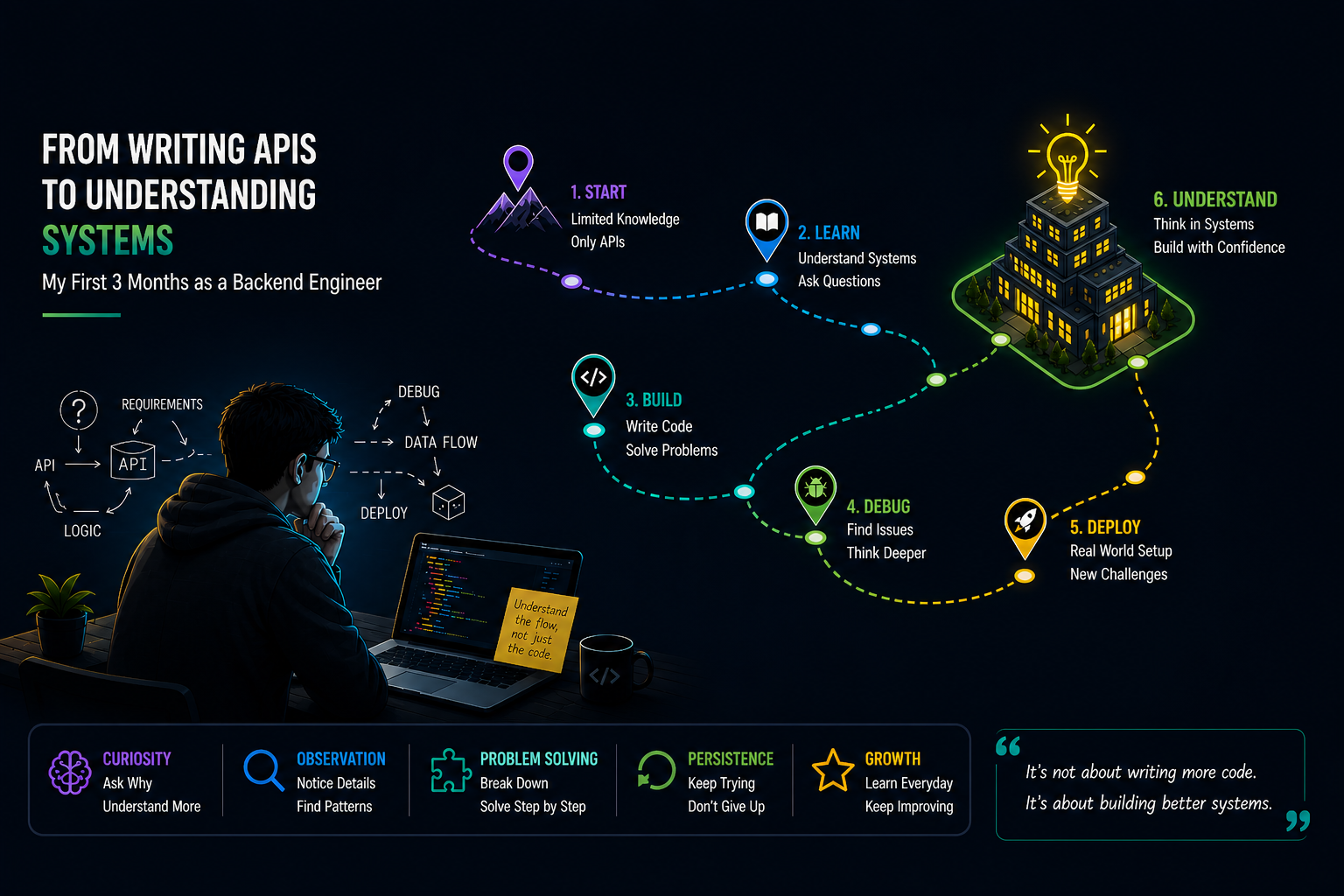
From Writing APIs to Understanding Systems: My First 3 Months as a Backend Engineer
3 min read
By Krushna Sonawane
From Writing APIs to Thinking in Systems: My First 3 Months as a Backend Engineer
When I started my journey as an intern, I believed backend development was mainly about writing APIs.
I was comfortable working with frameworks like FastAPI and had a basic idea of how systems should be structured. But that understanding was mostly theoretical.
Once I started working on real projects, I realized something important:
Writing APIs is easy. Understanding systems is not.
Where I Started
Before joining, my approach was simple:
- Take a requirement
- Write an API
- Return a response
I focused more on code than on how things actually worked behind the scenes.
I did not think much about:
- how data flows across the system
- how different components interact
- what happens when something breaks
The Shift: From Code to Flow
Working on a real backend system forced me to slow down and understand the complete flow.
Instead of just writing endpoints, I had to think about:
- how input is processed internally
- how data is validated before execution
- how different layers of the system connect
- how to handle incorrect or unexpected behavior
This was the point where backend stopped being just “code” and started becoming a system.
Learning to Handle Real Problems
One of the biggest differences between practice and real work is this:
In real systems, things fail in unexpected ways.
I faced multiple situations where:
- logic worked in theory but failed in execution
- small mistakes caused larger system issues
- fixing one part affected another part of the system
This forced me to move away from trial-and-error coding and start debugging properly.
I learned to:
- read logs carefully
- trace the flow step by step
- identify the root cause instead of guessing
My First Real Challenge: Deployment
Until this point, I had only worked in a local environment.
Running a full system with multiple services was a completely new experience.
Setting up containers, connecting services, and making everything run together was not straightforward.
The biggest challenge I faced was with the database setup.
- configuration changes were not reflecting
- authentication errors kept appearing
- the system behaved inconsistently
At one point, I was completely stuck.
What helped me move forward was:
- checking logs instead of guessing
- understanding how data is persisted
- asking for help when needed
This experience taught me that deployment is not just a final step—it is part of the system itself.
A Mistake That Changed My Approach
In the beginning, I relied heavily on AI-generated code.
It helped me move fast, but it also created a problem:
I was using code without fully understanding it.
This became a major issue when I had to debug or modify something.
I realized that:
- speed without understanding is risky
- generated code is not always reliable
- real confidence comes from understanding, not copying
After that, I started focusing more on:
- reading code carefully
- understanding logic before using it
- thinking through the flow
What Changed in My Thinking
Before:
- Focused on writing code quickly
- Thought backend = APIs
- Relied on output without validation
Now:
- Focus on understanding the complete system
- Think in terms of data flow, not just endpoints
- Validate logic before execution
- Treat debugging as a core skill
What I Understand Now
Backend development is not just about writing code.
It is about:
- how data moves through the system
- how components interact with each other
- how failures are handled
- how to keep the system reliable
Conclusion
My initial understanding of backend development was limited to writing APIs.
Working on real systems changed that completely.
Now, I approach problems with a focus on:
- system flow
- data correctness
- debugging and reliability
I am still learning, but this shift—from writing code to understanding systems—has been the most important part of my journey so far.