
Lessons From Building a Django Backend With a Small Team
5 min read
By Shobit Sharma
The Reality of Backend Development in a Team
Over the last month, we worked on a Django-based backend where multiple developers were building features in parallel.
On paper, it sounds straightforward:
- forms
- APIs
- authentication
- file uploads
- PostgreSQL
- Docker deployment
But in reality, backend development in a team is not just about writing code.
It’s about coordination.
It’s about discipline.
And most importantly — it’s about understanding how everything connects.
This is not about one project.
This is about what actually happens when a real backend is built by multiple developers.
Backend Development Is Not Just Writing Views
At the beginning, it's easy to think backend work means:
- write views
- save data
- return response
But very quickly, you realize it includes much more:
- database schema design
- model changes
- migrations
- validation
- authentication
- file handling
- API structure
- deployment
- team workflow
The important realization:
One small change in a model is never just a model change.
It can affect:
- database structure
- migration history
- production deployment
- other developers' work
That’s when you understand:
- Backend development is not just code
- It is a system of connected decisions
Migrations Are Not Just Commands — They Are a Contract
At first, migrations feel like routine commands:
python manage.py makemigrations
python manage.py migrate
But they represent something deeper.
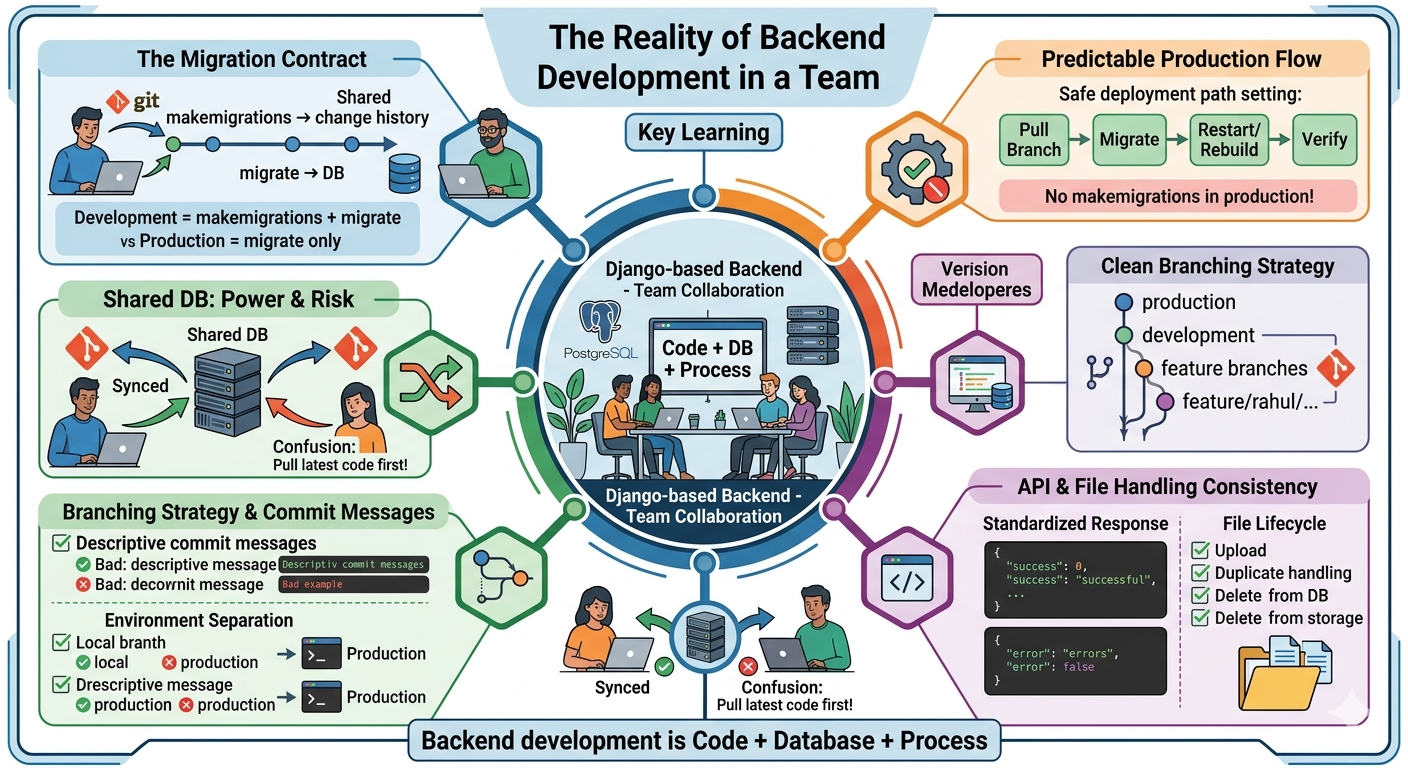
makemigrations→ creates change historymigrate→ applies that history to the database
Key learning:
- Migrations are the contract between your code and your database
Golden Rule:
Development = makemigrations + migrate
Production = migrate only
Production should never generate migrations.
It should only apply what is already reviewed and committed.
Shared Development Databases Are Powerful — And Risky
Working with a shared development database makes collaboration easier.
Everyone works on the same dataset.
Testing becomes realistic.
But it introduces a new kind of problem.
A simple scenario:
- Developer A creates a new table
- Runs migration on shared DB
- Table now exists
Meanwhile:
- Developer B hasn’t pulled the latest code
- But sees the new table in DB
Now confusion starts.
What We Learned
- Always commit migration files with model changes
- Pull latest code before creating new migrations
- Communicate before changing shared structures
- Avoid experiments on shared DB
A shared DB is useful — but without discipline, it becomes chaos.
Migration Conflicts Are Inevitable
When multiple developers work on models, conflicts are not a bug — they are expected.
Example:
- Two developers create migrations with same number
- Both are valid
- But Django doesn’t know the order
The solution:
python manage.py makemigrations --merge
The real lesson:
- Migration files are history
- Don’t rename, delete, or “fix” them randomly
Handle them carefully, like version control for your database.
Working With Existing Databases Requires Strategy
Not every project starts clean.
Sometimes:
- Tables already exist
- Data is already important
- No proper migration history exists
Deleting everything is not an option.
The Practical Approach
Treat the current database as a baseline:
- Keep existing tables
- Keep existing data
- Align models with DB
- Start proper migrations from now
This allows you to move from:
- unstructured development
- to controlled, trackable backend evolution
Production Is Not a Playground
This is one of the most important lessons.
Production must be predictable.
That means:
- No makemigrations in production
- No manual table creation
- No copying data manually
- No experimental changes
A Safe Deployment Flow
Pull approved branch
Apply migrations
Restart or rebuild service
Verify workflows
If Docker is involved:
- Code changes usually require rebuilding the container
Branching Strategy Is Not Optional
When multiple developers are involved, branching becomes critical.
A clean flow:
production
   ↓
development
   ↓
feature branches
   ↓
pull request
   ↓
testing
   ↓
merge to production
Naming matters too:
feature/rahul/inspection-upload
fix/sneha/duplicate-check
update/amit/report-flow
Clear names reduce confusion during reviews and deployment.
Commit Messages Decide Your Future Pain
At the moment, writing:
update
changes
final
feels fine.
Later, it becomes a nightmare.
What Works Better
Add duplicate check for village records
Fix file deletion during edit flow
Update asset valuation calculation
Good commits help in:
- debugging
- rollback
- code review
- tracking changes
APIs Should Be Predictable
Even in server-rendered apps, APIs exist.
And inconsistency creates unnecessary frontend problems.
A Simple Rule
Success:
return JsonResponse({"success": True, "data": payload})
Error:
return JsonResponse({"success": False, "error": "village is required"}, status=400)
- Consistency reduces confusion. Always.
File Upload Is Not Just Upload
Saving a file is just the beginning.
A complete flow includes:
- upload
- multiple files
- preview/download
- edit without losing data
- duplicate handling
- deletion from DB
- deletion from storage
Common Mistakes
- Deleting DB record but not file
- Replacing files unintentionally during edit
File handling must be tested across full lifecycle, not just upload.
Environment Separation Prevents Mistakes
Mixing local and production behavior is dangerous.
Clear Separation
Local:
- runserver
- makemigrations
- migrate
- testing
Production:
- pull code
- migrate
- restart/rebuild
- verify
This prevents accidental production damage.
Backend Is Not Just Code — It Is Process
This is the biggest realization.
A good backend answers:
- Where do I start work?
- When do I create migrations?
- Who runs migrations?
- What happens during conflicts?
- What goes to production?
If unclear:
- mistakes multiply
- progress slows
If clear:
- development becomes smooth
Final Thought
At first, process feels like overhead.
But over time, you realize:
- Process is what keeps the system stable
The Real Takeaway
Backend development is code + database + process
If all three are handled properly:
- development becomes faster
- deployments become safer
- and the system becomes easier to scale