
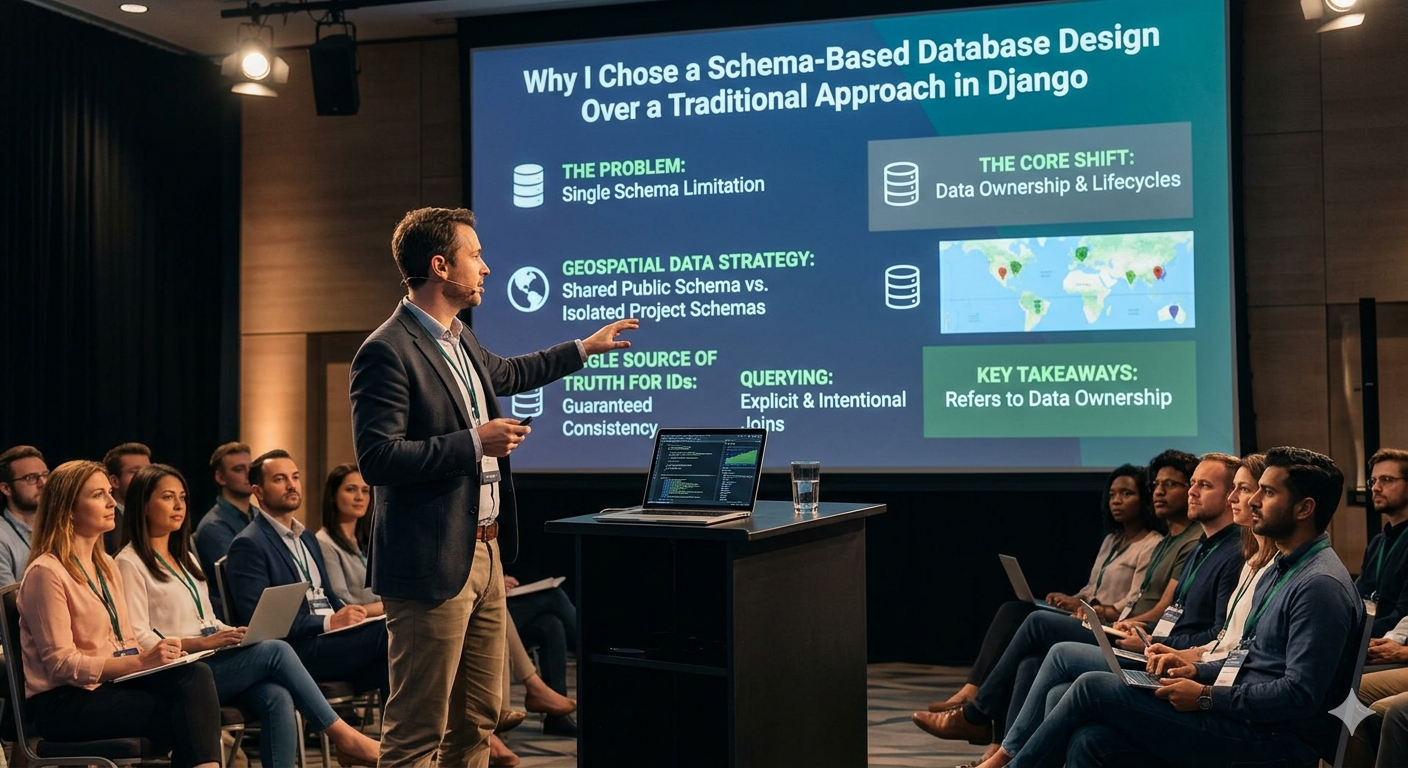
Why I Chose a Schema-Based Database Design Over a Traditional Approach in Django Introduction
4 min read
By Ankush Jadhav
The Problem Backend Developers Eventually Hit At the start, everything feels clean.
You create a Django project, define models, run migrations — all tables go into public, and life is simple.
But then the system grows.
You start dealing with:
- Large datasets
- Domain-heavy logic
- Reusable data across modules
- And in my case — geospatial data across multiple projects
And suddenly, the database becomes the bottleneck — not performance-wise, but design-wise.
Tables start piling up.
Relationships become harder to reason about.
And worst of all — you lose clarity about what data belongs where.
The Real Issue Was Not Django — It Was Data Organization
Django apps were modular. Code was clean.
But the database?
Everything lived in one place:
public.*
That meant:
- Shared data and project data were mixed
- Same type of data existed in multiple places
- Reusability became painful
- Any structural change felt risky
At some point, it became clear:
- The problem wasn’t models
- The problem was lack of separation at the database level
The Turning Point: Thinking in Terms of Data Ownership
Instead of asking:
“Which table should I create?”
I started asking:
“Who owns this data, and will it be reused?”
That one shift changed everything.
The Approach: Schema-Based Separation
I moved from a flat structure to a schema-based design in PostgreSQL.
Core idea:
publicschema → shared, reusable geospatial data- Project-specific schemas → dynamic, evolving data
The GIS-Specific Realization (This Changed Everything)
When working with geospatial systems, one thing becomes obvious:
Some data is universal.
- District boundaries
- Taluka boundaries
- Village geometries
This data:
- Does not change often
- Is used across multiple projects
- Should never be duplicated
So instead of copying it everywhere, I treated it as:
A central, authoritative dataset inside public
Project Data Lives Separately
Each project gets its own schema.
That schema contains:
- Project-specific features
- Asset layers (points, lines, polygons)
- Survey or transactional data
So instead of mixing everything:
public.boundaries         ✅ shared
project_x.assets          ✅ isolated
project_y.assets          ✅ isolated
This ensures:
- No overlap
- No duplication
- No confusion
The Most Important Decision: Single Source of Truth for IDs
This is where things get really important.
Instead of redefining location data per project:
- I used IDs from the
publicschema as the only source of truth
That means:
- Every project references the same district/taluka/village IDs
- No duplicate identity systems
- No mismatched records
What This Solves
- Data consistency across schemas
- Reliable joins between datasets
- Easier aggregation and reporting
- Zero duplication of core entities
How Queries Became Better (and More Honest)
Once schemas were introduced, queries became explicit.
No more guessing.
SELECT b.geom, b.id, b.name
FROM project_schema.asset_data a
JOIN public.location_master b
ON a.location_id = b.id;
Now the query clearly tells:
- What is project data
- What is shared reference data
- How they are connected
This level of clarity is something you don’t get in a flat schema.
The Challenges (This Was Not Easy)
Let’s be real — this approach is not plug-and-play.
Django ORM Doesn’t Think in Schemas
Django assumes everything is in public.
So:
- You have to explicitly define schema in table names
- ORM abstraction becomes limited
- Sometimes raw SQL is unavoidable
Migrations Become Less Straightforward
- Schemas must exist before migrations
- Ordering matters
- Deployment needs extra care
This is where you stop relying blindly on Django and start understanding PostgreSQL properly.
Cross-Schema Joins Need Discipline
Just because you can join everything doesn’t mean you should.
If misused:
You recreate the same mess, just across schemas
So:
- Shared schema → read-only mindset
- Project schema → isolated logic
- Keep boundaries clean
Debugging Requires Awareness
Wrong schema = wrong data.
There’s no safety net here.
You need:
- Strong naming conventions
- Clear query understanding
- Awareness of data flow
What Changed After This
This wasn’t just a database change — it changed how I think about backend systems.
- I stopped thinking in tables → started thinking in data domains
- I stopped duplicating data → started enforcing single source of truth
- I stopped relying fully on ORM → started understanding SQL deeply
When This Approach Actually Makes Sense
Use this if:
- You are working with multiple projects sharing the same base data
- You deal with GIS or structured domain-heavy datasets
- You need clear separation of reusable vs project data
Avoid if:
- Your app is small
- No shared datasets exist
- You just need speed over structure
Final Thought
Most developers scale code first.
But real systems fail at the data layer, not the API layer.
Once you start thinking:
“This data belongs here, and only here”
Instead of:
“Let me just create another table”
That’s when your system starts becoming:
- Scalable
- Maintainable
- And actually understandable