
Understanding Django Tenants: A Beginner's Guide to Multi-Tenant Architecture
4 min read
By Ankush Jadhav
Python-Django
Introduction
Have you ever wondered how platforms like Shopify, Notion, or Salesforce serve thousands of customers from a single application while ensuring every customer's data remains completely isolated?
That's exactly the problem Django Tenants solves.
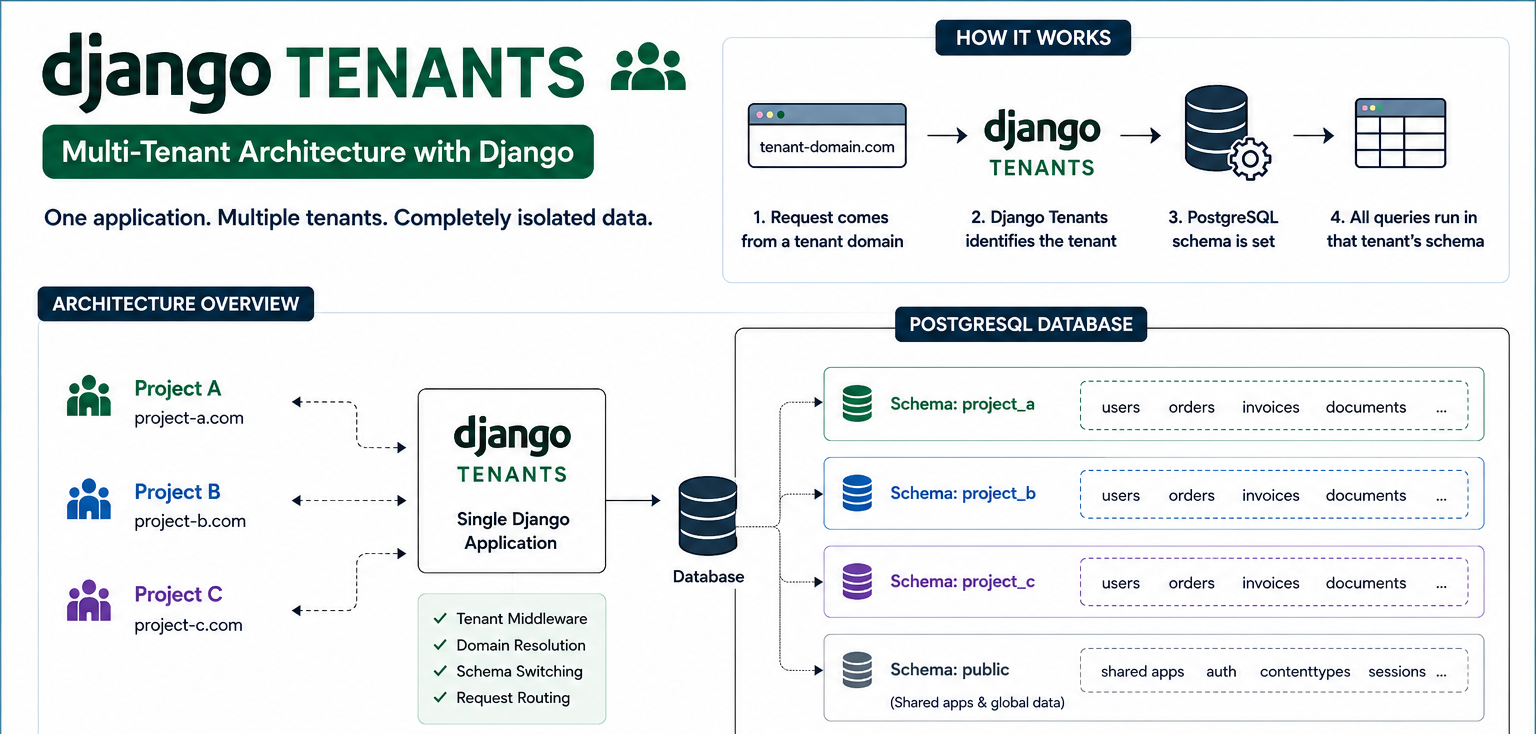
Instead of maintaining separate Django projects or databases for every customer, django-tenants allows you to build multi-tenant applications using PostgreSQL schemas, enabling multiple organizations to share the same Django application while keeping their data completely isolated.
What is Django Tenants?
Django Tenants is an open-source package that adds multi-tenancy support to Django using PostgreSQL schemas.
Instead of running multiple copies of your application, you can run one Django project for multiple customers.
With Django Tenants, you get:
- One Django application
- One PostgreSQL database
- Multiple organizations (tenants)
- Complete data isolation
- Better scalability
- Easier maintenance
- Lower infrastructure cost
Each tenant has its own PostgreSQL schema while sharing the same Django application code.
Understanding PostgreSQL Schemas
A PostgreSQL schema is similar to a folder inside a database.
Just like two folders can contain files with the same name, two schemas can contain tables with identical names without conflicting with each other.
Example
Database
│
├── public
│
├── Project A
│   ├── users
│   ├── projects
│   ├── properties
│   └── documents
│
├── Project B
│   ├── users
│   ├── projects
│   ├── properties
│   └── documents
│
└── Project C
    ├── users
    ├── projects
    ├── properties
    └── documents
Each organization stores its own data while using the same Django application.
Three Ways to Implement Multi-Tenancy
There are three common approaches for building multi-tenant applications.
1. Separate Database for Every Tenant
Each customer has a completely separate database.
Pros
- Strong data isolation
- Independent backups
- Easy database migration
Cons
- Expensive infrastructure
- Higher maintenance
- Multiple database connections
2. Shared Database with Separate Schemas (Django Tenants)
All tenants share one PostgreSQL database.
Each tenant has its own schema.
Pros
- Excellent performance
- Better resource utilization
- Easy maintenance
- Complete data isolation
- Highly scalable
This is the architecture implemented by django-tenants.
3. Shared Database with Shared Schema
Everyone shares the same tables.
Each row belongs to a tenant using a Tenant ID.
Pros
- Easy setup
- Lower storage usage
Cons
- Every query requires filtering
- Greater chance of accidental data leakage
- Difficult to maintain as the application grows
Real-World Example
Imagine you're building a Property Management SaaS.
Your customers are:
- Project A
- Project B
- Project C
All three organizations access the same application.
https://app.example.comHowever, behind the scenes Django automatically switches to the correct PostgreSQL schema.
Project A
↓

Schema: project_a

Project B
↓

Schema: project_b

Project C
↓

Schema: project_c
Now, when a user from Project A executes:
Property.objects.all()Django automatically queries:
SELECT * FROM project_a.property;If a user from Project B executes the exact same code:
Property.objects.all()Django queries:
SELECT * FROM project_b.property;The code never changes—only the schema does.
This is one of the biggest advantages of Django Tenants.
How Django Tenants Works
When a user opens your application, Django identifies the tenant based on the domain name.
Example:
https://project_a.example.comThe request follows this flow:
Incoming Request
        │
        ▼
Tenant Middleware
        │
        ▼
Identify Tenant
        │
        ▼
Set PostgreSQL Search Path
        │
        ▼
Execute ORM Queries
Once the tenant is identified, Django automatically switches to the correct PostgreSQL schema.
Example:
Search Path

project_a, public
Now every ORM query automatically runs inside the project_a schema.
Property.objects.all()No additional filters are required.
Key Features
- Unlimited tenants
- Single Django application
- Single PostgreSQL database
- Separate schema for every tenant
- Domain-based tenant identification
- Automatic schema switching
- Shared and tenant-specific applications
- Tenant-specific routing
- Minimal changes to existing Django projects
- High scalability
Advantages vs Challenges
Advantages
- Complete data isolation
- One codebase for multiple customers
- Lower infrastructure cost
- Better performance with shared database resources
- Easy onboarding of new tenants
- Automatic schema switching
- Cleaner architecture for SaaS applications
- Less maintenance compared to managing multiple databases
Challenges
- Works only with PostgreSQL
- Cross-tenant reporting requires additional handling
- Schema migrations may take longer with many tenants
- Requires understanding of PostgreSQL schemas before implementation
Why Choose Django Tenants?
One of the biggest advantages of Django Tenants is that you don't need to change the way you write Django code.
Your existing models, views, serializers, and ORM queries continue to work exactly as before.
Django Tenants automatically:
- Detects the tenant
- Switches the PostgreSQL schema
- Executes queries against the correct tenant
- Keeps tenant data completely isolated
This allows developers to focus on building features instead of managing multiple databases.
Real-World Use Cases
Django Tenants is an excellent choice for:
- SaaS Platforms
- ERP Systems
- CRM Applications
- Government Portals
- Land Management Systems
- Hospital Management Systems
- School Management Systems
- Real Estate Platforms
- Property Management Systems
- Enterprise Business Applications
Final Thoughts
If you're building a Django application that serves multiple organizations, Django Tenants provides one of the cleanest, most scalable, and maintainable solutions available.
By leveraging PostgreSQL schemas, it enables multiple customers to share a single Django application while ensuring each tenant's data remains completely isolated.
With Django Tenants, you can:
- Build scalable SaaS applications
- Reduce infrastructure costs
- Maintain a single codebase
- Improve application performance
- Securely isolate customer data
- Simplify long-term maintenance
Whether you're building your first SaaS platform or scaling an enterprise application, learning Django Tenants is a worthwhile investment. Combined with Django's powerful ORM and PostgreSQL schemas, it offers one of the most elegant approaches to multi-tenant application development.
Read Documentation
Django-Tenant Documentation
https://django-tenants.readthedocs.io/
GitHub Repository
https://github.com/django-tenants/django-tenants
Thank You for Reading!
I hope this article helped you understand how Django Tenants simplifies building scalable multi-tenant applications with Django.
I'm currently exploring Django, PostgreSQL, GIS, Docker, System Design, and scalable backend architectures. I'll continue sharing practical articles, real-world implementations, and development tips based on my learning journey.
If you found this article helpful, feel free to connect with me and stay tuned for more technical blogs.
Happy Coding! 🚀