
Why Good Data Matters More Than a Bigger AI Model
7 min read
By Devendra Solanki
AIML
Why Good Data Matters
More Than a Bigger AI Model
A Practical Guide to Building Reliable AI Systems
AI Engineering • Data Quality • Machine Learning • Computer Vision
1. Introduction — The Bigger Model Trap
When an AI system performs poorly, one of the first questions teams often ask is: “Do we need a bigger model?” The answer is sometimes yes—but very often, the real problem is not model size at all. It is the quality of the data used to train, validate, and evaluate the system.
Modern AI models can contain billions of parameters and can learn remarkably complex patterns. However, a sophisticated model cannot magically recover information that is missing, incorrect, biased, duplicated, or poorly labeled in the training data. The model learns from the examples it receives.
| Core Principle A larger model does not automatically compensate for poor data. Reliable AI starts with reliable data. |
This is why data quality is one of the most important—and sometimes underestimated—parts of AI engineering. In production systems, improving the dataset can deliver a larger practical improvement than simply replacing a model with a larger architecture.
2. What Does “Good Data” Actually Mean?
Good data is not simply a large collection of files. A high-quality AI dataset should represent the real problem the model will face after deployment. Several properties matter:
| Data Quality Factor | Why It Matters |
| Accuracy | Labels and input data should correctly represent the underlying reality. |
| Consistency | The same annotation rules and data standards should be applied across the dataset. |
| Coverage | The dataset should cover important scenarios, environments, and edge cases. |
| Diversity | Examples should vary across viewpoints, lighting, weather, devices, locations, and conditions where relevant. |
| Relevance | The data should represent the actual business or operational problem. |
| Balance | Important classes and scenarios should not be severely underrepresented. |
| Freshness | Data should reflect the current environment when the real-world distribution changes over time. |
3. Garbage In, Garbage Out — But for AI
The classic principle of “garbage in, garbage out” applies strongly to machine learning. If the training data contains systematic errors, the model may learn those errors as if they were valid patterns.
Common examples include:
- Incorrect annotations or mislabeled samples.
- Images that are too blurry or low-quality for the intended task.
- Duplicate or near-duplicate samples that artificially inflate the dataset size.
- Missing examples for important classes.
- Inconsistent annotation policies between annotators.
- Training and validation data that are too similar.
- Data leakage, where information from the evaluation set indirectly appears during training.
- Sampling bias, where the dataset represents only a narrow part of the real world.
In these situations, adding more model capacity may increase the model's ability to fit the dataset, but it does not necessarily make the system more reliable in production.
4. More Data Does Not Always Mean Better Data
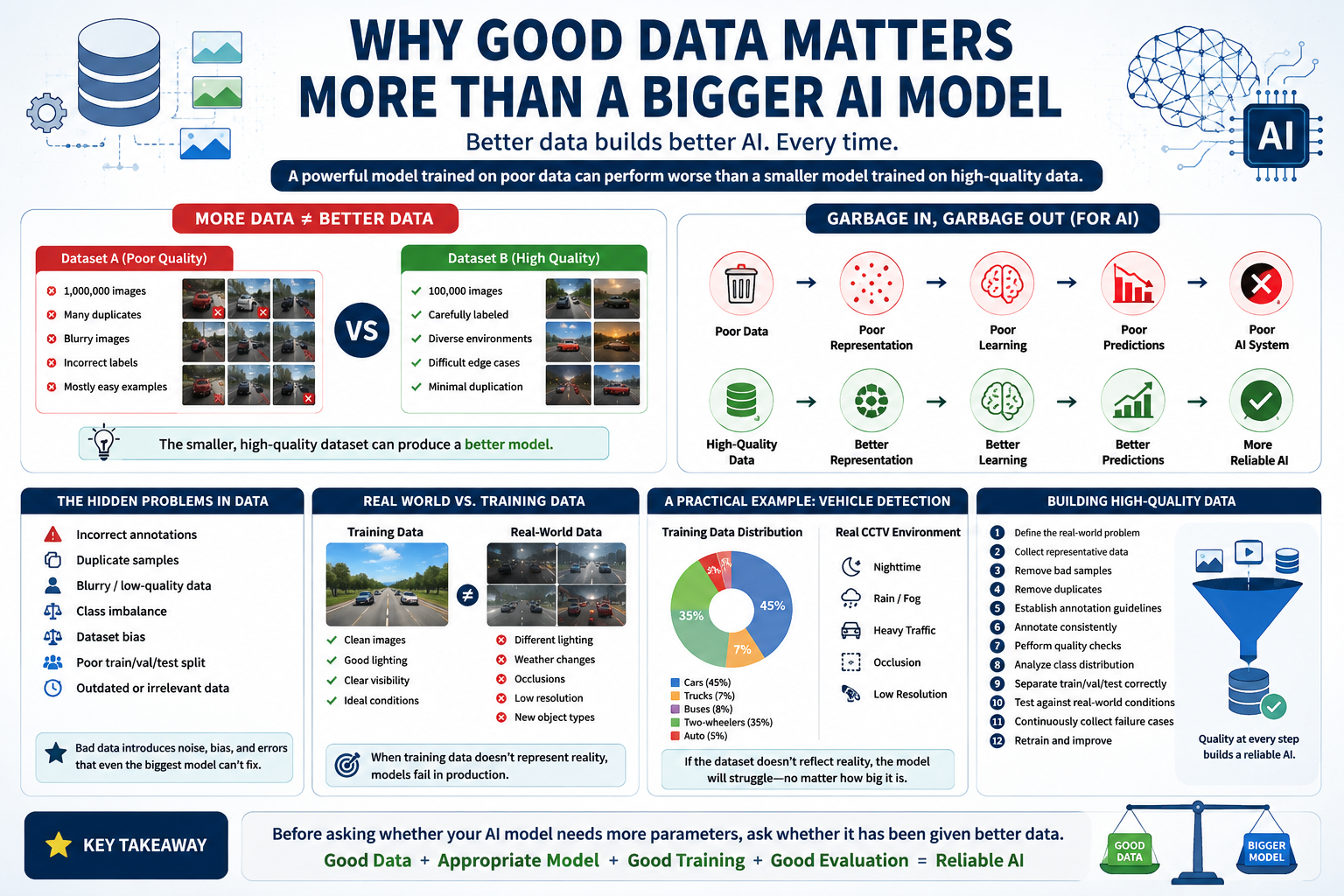
Dataset size is important, but raw quantity is only one dimension of dataset quality. A million weak examples can be less useful than a much smaller dataset that is accurate, diverse, representative, and carefully curated.
Consider a simplified example:
| Dataset | Characteristics | Likely Outcome |
| Dataset A | 1,000,000 images, many duplicates, inconsistent labels, limited conditions | Large but potentially weak generalization |
| Dataset B | 100,000 carefully labeled, diverse, representative images | Smaller but potentially stronger real-world performance |
The objective should therefore not be “collect as many samples as possible.” The objective should be “collect enough high-quality samples to represent the problem correctly.”
5. Hidden Problems Inside AI Datasets
Many dataset problems are difficult to notice simply by looking at the total number of images or records. A dataset can look large and still contain serious quality issues.
- Label errors — the object or class is annotated incorrectly.
- Annotation inconsistency — different annotators follow different rules.
- Duplicates — identical or near-identical samples appear multiple times.
- Class imbalance — one class dominates while another has too few examples.
- Poor train/validation split — highly similar frames from the same source appear in both sets.
- Label leakage — information unavailable at inference time is accidentally exposed during training.
- Outliers — unusual or corrupted samples can distort training.
- Domain bias — the dataset represents one camera, location, demographic, environment, or operating condition too strongly.
| Important Dataset analysis should be treated as an engineering activity, not just a preprocessing step. |
6. Why AI Models Fail in the Real World
A model can achieve excellent validation metrics and still perform poorly after deployment. One major reason is distribution shift: the data encountered in production is different from the data used during training.
For example, a computer vision model may be trained mostly on:
- Clear daytime images
- High-resolution cameras
- Limited viewpoints
- Good lighting
- Unoccluded objects
But the production environment may contain:
- Night-time or low-light scenes
- Rain, fog, glare, or dust
- Different camera angles
- Compression artifacts
- Crowded scenes and heavy occlusion
- Small objects far from the camera
- Different camera models and resolutions
The model has not necessarily become worse. The world has changed relative to what it learned. This is why production data and real-world evaluation are critical.
7. A Bigger Model Cannot Fix a Data Problem
Suppose a training dataset contains thousands of incorrect labels. Increasing model size does not tell the model which labels are wrong. It may simply give the model more capacity to learn the dataset—including its mistakes.
Similarly, if a dataset contains almost no examples of an important production scenario, a larger model cannot learn that scenario without representative examples.
| Think of it this way Model architecture determines how much the system can learn. Data determines what the system has the opportunity to learn. |
8. Data Quality Often Has Better ROI Than Model Complexity
Before moving from a smaller model to a much larger model, teams should ask whether the current performance bottleneck is actually model capacity.
High-value improvements may include:
- Correcting systematic annotation errors.
- Adding missing production scenarios.
- Removing duplicates and corrupted samples.
- Improving class balance.
- Adding difficult examples and edge cases.
- Improving the train/validation/test split.
- Creating a realistic production test set.
- Tracking and retraining on failure cases.
These changes can be cheaper, easier to audit, and more directly connected to the failure modes seen in production.
9. Practical Computer Vision Example
Consider a vehicle detection system designed to identify cars, two-wheelers, auto-rickshaws, buses, and trucks from CCTV footage.
A common mistake is to focus immediately on model architecture: choosing a larger backbone, increasing image resolution, or switching to a more expensive inference engine.
But suppose the dataset has these problems:
- Cars greatly outnumber trucks.
- Many images are blurry because of the source CCTV footage.
- Some classes contain inconsistent annotations.
- Training images come from only a small number of camera viewpoints.
- Validation images are visually similar to training images.
- Rare but important traffic situations are missing.
In that situation, the first engineering priority should be dataset improvement. A larger model may improve benchmark numbers, but it does not automatically solve class imbalance, missing scenarios, blurred inputs, annotation errors, or an unrealistic validation split.
10. How to Build a High-Quality AI Dataset
A practical dataset workflow can be organized into the following steps:
Define the problem precisely: Specify classes, expected inputs, deployment environment, and success criteria.
Collect representative data: Capture the environments, viewpoints, conditions, and variations expected in production.
Clean the data: Remove corrupted, unusable, irrelevant, and poor-quality samples according to the task requirements.
Deduplicate: Detect exact and near-duplicate samples to avoid artificially inflating dataset size.
Create annotation guidelines: Document clear rules for what should and should not be labeled.
Perform annotation quality checks: Review samples, measure consistency, and resolve ambiguous cases.
Analyze class distribution: Identify underrepresented classes and scenarios.
Split data correctly: Prevent leakage and ensure validation/test data represent genuinely unseen conditions.
Create a real-world test set: Keep a separate set that closely reflects deployment conditions.
Track failure cases: Collect false positives, false negatives, missed objects, and difficult examples.
Iterate: Use production failures to improve the dataset and retrain the model.
11. The Data Flywheel
Reliable AI systems improve through an iterative data flywheel rather than a one-time training process:
1. Real-world environment
2. Data collection
3. Cleaning and annotation
4. Model training
5. Deployment
6. Failure analysis
7. New representative data
8. Retraining and evaluation
The most valuable data often comes from the model's failures. A missed detection, incorrect classification, or false alarm is not only an error—it is evidence about where the system's understanding is incomplete.
12. Should We Stop Building Bigger Models?
No. Larger and more capable models are extremely valuable. Model architecture, pretraining, optimization, inference efficiency, and fine-tuning all matter.
The important lesson is that model size should not be treated as the default solution to every AI problem.
| Component | Role |
| Data | Provides the examples and information from which the system learns. |
| Model | Provides the capacity and structure for learning patterns. |
| Training | Determines how effectively the model learns from the data. |
| Evaluation | Measures whether the learned behavior generalizes. |
| Deployment feedback | Reveals how the system behaves under real-world conditions. |
| Reliable AI Formula Good data + appropriate model + effective training + realistic evaluation + continuous feedback = a stronger production system. |
13. Conclusion
The AI industry often celebrates larger models, more parameters, and higher benchmark scores. Those advances are important, but they can distract from one of the most fundamental truths in machine learning: the quality of the learning signal matters enormously.
A model can only learn from the information available to it. If the dataset is inaccurate, biased, incomplete, duplicated, or unrepresentative, increasing model size may not solve the underlying problem.
For AI engineers, therefore, dataset quality should be treated as a first-class engineering concern. Before asking whether the model needs to become bigger, ask whether the data needs to become better.
Build better data. Then build better models.